Comparison of Spatial Transcriptomics Technologies

category_1
category_2
category_3
category_4

Write a description of the lesson here.

Author

Noor Sohail

Published

July 22, 2025

Keywords

keyword_1, keyword_2, keyword_3, keyword_4, keyword_5, keyword_6

Approximate time: XX minutes

Learning objectives

In this lesson, we will:

  • Follow the evolution of high-throughput sequencing
  • Describe the differences in sequencing- and imaging-based technologies
  • Define the advantages and disadvantages of different spatial transcriptomics technologies

Overview of lesson

When doing XYZ…

High-throughput sequencing overview

Over the years, transcriptomics technologies have evolved rapidly from bulk sequencing, to single-cell sequencing, all the way to the current spatial transcriptomics methods.
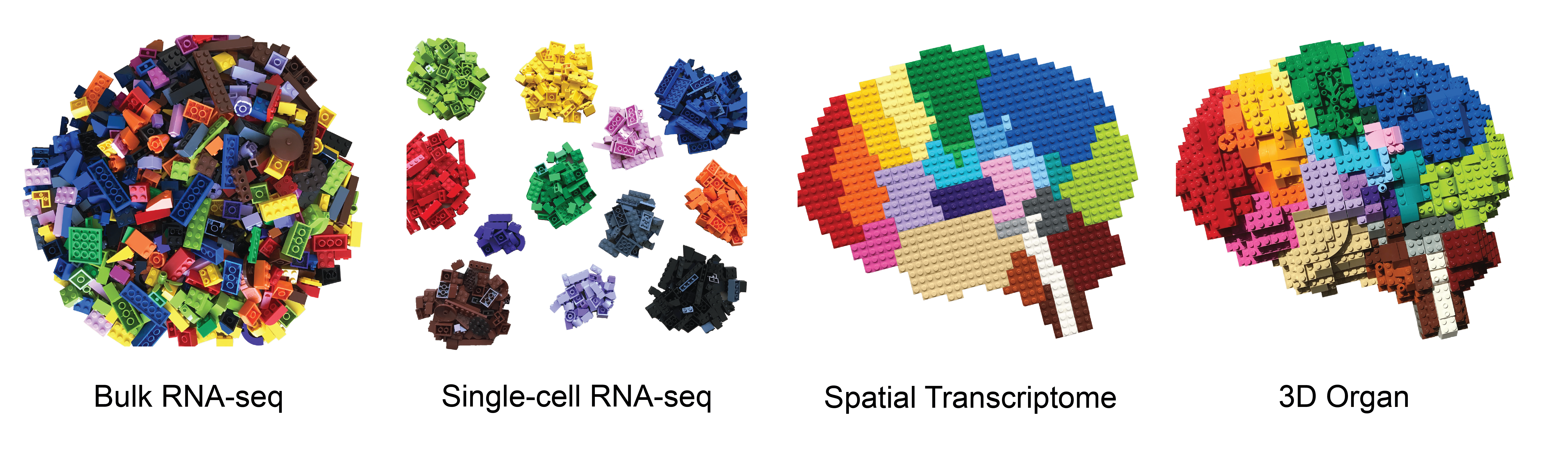
Figure 1: Lego representation of the evolution of sequencing technologies, showing more specificity and structure with each advancement.
Image source: Bo Xia Lab

Bulk and single-cell sequencing

Bulk RNA-seq is a method for comparing the averages of cellular expression for a population of cells. This method can be a good choice if looking at comparative transcriptomics (e.g. samples of the same tissue from different species), and for quantifying expression signatures in disease studies. It also has potential for the discovery of disease biomarkers if you are not expecting or not concerned about cellular heterogeneity in the sample.

To contrast, single-cell sequencing is a method for measuring gene expression on a per-cell basis. This method is ideal for studies of cellular heterogeneity where the differences between celltypes or cell states are the primary focus.

Figure 2: Comparison of bulk and single-cell RNA sequencing approaches, showcasing loss of cellular resolution in bulk due to averaging.
Image source: Trapnell et al. (2015)

To give an example, if we look at the image above, we can see that there are two cell types (blue and green) that have different expression patterns for genes A and B. If we were to analyze this data in bulk (left), we would not be able to detect the correct association between the genes. However, if we properly group the cells by cell type (right), we can see the correct correlation between the genes.

Spatial transcriptomics

Spatial transcriptomics extends the concept of single-cell sequencing further by adding the coordinates for each cell or spot on a slide. This allows us to understand both the molecular and spatial context for gene expression. Many of the challenges of scRNA-seq are also present in spatial transcriptomics.

Studies that focus on the tissue microenvironment benefit from location information, as nearby cells are more likely to interact with one another. Another potential application is the ability to annotate key areas of a tissue based upon the histological features of the tissue, which can be particularly useful for studies of cancer and other diseases.

Figure 3: Example of histology slide from a liver biopsy, annotated by a pathologist.
Image source: Holzinger et al. (2019)

Many of the challenges that arise in single-cell experiments are also present in spatial, for example:

  • Large volume of data
  • Low depth of sequencing per cell
  • Technical variability across cells/samples
  • Biological variability across cells/samples

These technologies can be broadly categorized into two groups: sequencing-based and imaging-based. We will now discuss the different technologies within each of these categories as well as their advantages and disadvantages.

Warning

TODO: want a visual representation of differences between seq and imaging technologies

Sequencing-based technologies

Figure 4: Comparison of Visium and Visium HD data in FFPE human colorectal cancer, showcasing the resolution that can be achieved with sequencing-based methods.
Image source: 10X Genomics: Your introduction to Visium HD

Sequencing-based methods focus on capturing the full transcriptome of the cells in the dataset. To accomplish this, the tissue is “binned” into different spots which are then sequenced to measure expression levels. At times, a spot can be comprised of multiple cells (i.e., not single-cell level). As the technology has evolved, the bin sizes have become smaller, allowing for near single-cell resolution.

Advantages and disadvantages

Advantages:

  • Analyses that make use of many genes at once (functional analysis, RNA velocity, etc.) can be done on these datasets as you are sequencing the entire transcriptome instead of a gene panel.
  • Can be run on non-model organisms with greater ease.

Disadvantages:

  • High resolution experiments (Visium HD) can be very expensive
  • Spots are not guaranteed to be a single-cell (can be multiple cells, or no cells at all)

Imaging-based technologies

Figure 5: Showcase of MERFISH, an imaging-based technology, which can achieve single-cell resolution.
Image source: Vizgen: Leading the Global Expansion of Spatial Transcriptomics

These methods utilize fluorescence to quantify gene expression on a tissue slide, specifically fluorescence in situ hybridization (FISH) to measure expression of a selected panel of genes using probes. Therefore, we are able to evaluate expression for each individual cell after segmentation.

Advantages and disadvantages

Advantages:

  • Can be used to evaluate the expression of a select panel of genes with high sensitivity and specificity.
  • Single-cell resolution

Disadvantages:

  • Limited to a select panel of genes.
  • Segmentation is not a trivial task and requires careful preprocessing.
  • Challenging with non-model organisms as probes are necessary.

Summary of comparison

Table 3: Table: Summary of the advantages and disadvantages of sequencing- and imaging-based spatial transcriptomics technologies.
Adapted from:Single Cell Discoveries
Feature Sequencing-based Imaging-based
What they measure Whole transcriptome Targeted panels
Spatial resolution Multi-cell (spots/bins) to single cell Single cell
Sensitivity Broad detection; may miss low-abundance genes High for targeted genes
Limitations Mixing of cells in one spot Limited number of probes
Throughput (slides) High (parallel processing) Lower (multiple imaging cycles)
Throughput (genes) High (dozens of thousands) Limited (hundred to thousand*)
Cost More cost-effective at scale Higher per sample
Best for… Discovery projects Validation projects

Experimental design considerations

When designing a spatial transcriptomics experiment, there are several factors to consider:

Warning

TODO: Talk with single-cell core about good design

References

  • https://www.nature.com/articles/s41581-024-00841-1
  • https://www.sciencedirect.com/science/article/pii/S1044532325000302
  • https://www.nature.com/articles/s41581-024-00841-1/tables/1

Next Lesson >>

Back to Schedule

Reuse

CC-BY-4.0