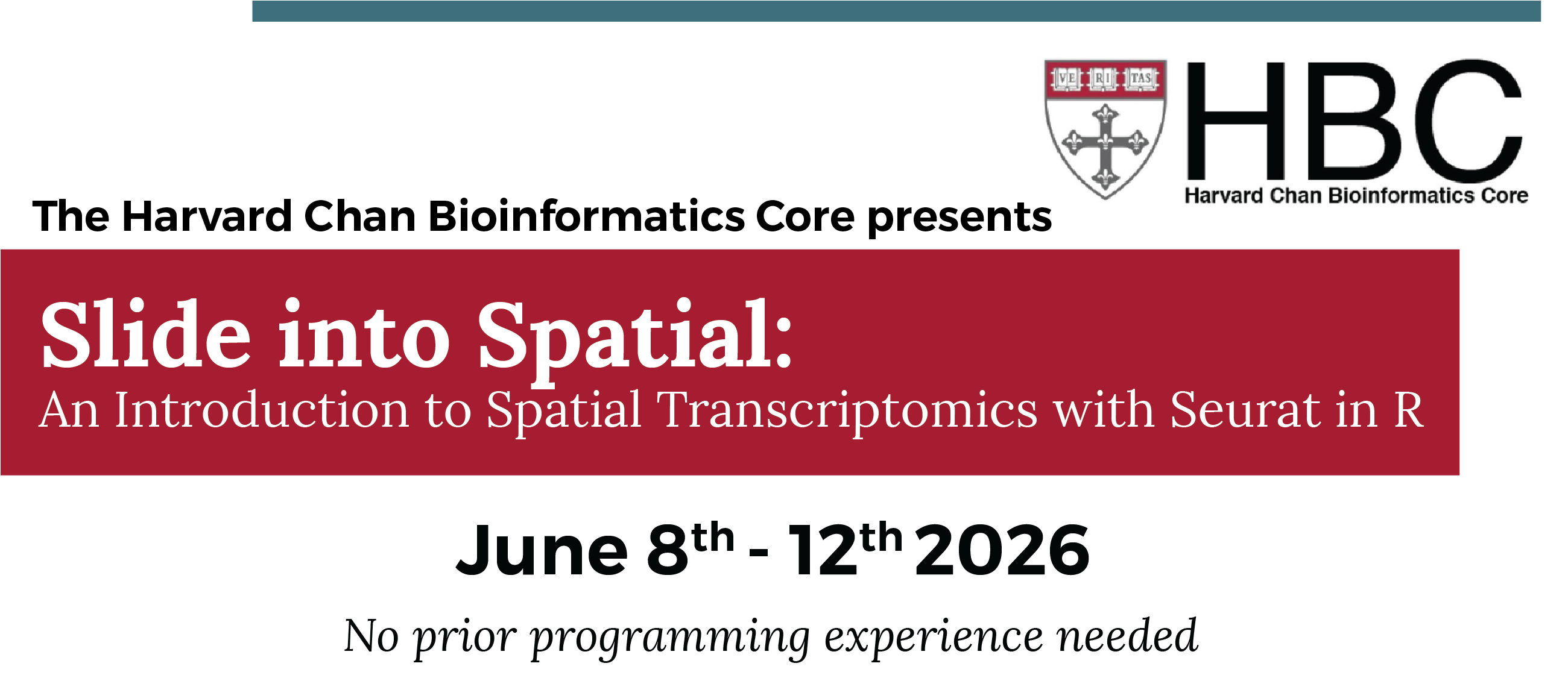
Workshop Details:
This hands-on workshop spans 5 consecutive days with 4.5 hours of synchronous teaching time and up to 2 hours of homework per day. The workshop is designed for beginners without any programming experience. All sessions will be held online over Zoom.
Morning sessions: 9:30 AM - 12 PM ET
Afternoon sessions: 1:00 PM - 3:00 PM ET
Description:
Discover the power of spatial transcriptomics in this hands-on, beginner-friendly workshop.
Spatial transcriptomics is the latest innovation in high-throughput sequencing, combining the sensitivity of single-cell sequencing with the spatial context of a tissue. If you have ever wanted to take your analysis into your own hands, then this workshop is for you! Without any prior programming experience, you will get hand-on experience analyzing Visium HD data with instructors guiding you.
The first two days will be spent bringing everyone up to speed on the basics of R programming and scripting. With that foundation in place, we’ll move on to spatial analyses using Seurat. We will follow the best practices for quality control and clustering. You’ll learn how to deconvolve the dataset to annotate cell types, then run differential gene expression to uncover meaningful transcriptional changes. Finally, we’ll utilize the “spatial” half of spatial transcriptomics: you’ll calculate spatially constrained clusters, identify spatially variable genes and investigate cell–cell communication through ligand–receptor analysis. Throughout this process, we will be interpreting the biological implications of each of these steps.
By the end of the workshop, you won’t just have watched someone else analyze spatial data — you’ll have done it yourself! You’ll leave with the ability to use R, apply different algorithms and be able to apply these tools to your own research.
Who should attend?
Any interested individuals who are keen in obtaining a foundational understanding of the workflow for analyzing spatial transcriptomics data in R.
We encourage academic and industry researchers who are working on spatial transcriptomics data or have plans to embark on spatial transcriptomic experiments in the near future to apply to this workshop.
Registration:
To register for the course please click on the link below. If you are one of the first 25 registrants, you will receive an email within one week with a link to pay the (non-refundable & non-transferable) registration fee.
Cost:
There is a non-refundable and non-transferable registration fee for this workshop. The registration fee options are outlined below.
Early Bird Pricing available until May 8th!
| Rate Category | Early Bird | Regular Rate |
|---|---|---|
| Harvard Academic | $860 USD | $960 USD |
| External Academic | $1125 USD | $1250 USD |
| Industry | $1575 USD | $1750 USD |
Due to limited space the workshop can accommodate maximum of 25 participants. Seats are assigned on a first come, first serve basis.
Workshop Outline:
Day 1:
- R syntax: Understanding the different ‘parts of speech’ in R; introducing variables and functions, demonstrating how functions work, and modifying arguments for specific use cases.
- Data structures in R: Getting a handle on the classes of data structures and the types of data used by R. Reading data into R and using functions to inspect it.
Day 2:
- Data inspection and wrangling: Using indices and various functions to subset and create datasets, including the tidyverse suite of packages.
- Visualizing data: Visualizing data using plotting functions from the external package ggplot2.
- Exporting data and graphics: Generating new data tables and plots for use outside of the R environment.
Day 3:
- Experimental considerations for spatial transcriptomics: A practical guide on setting up a successful single cell experiment and detailed information on different platforms.
- Quality control: Understand the Space Ranger output, while exploring additional quality control metrics using the Seurat object and various data visualizations in R.
- Normalization and sketch downsampling: Normalize your spatial transcriptomics data in order to make comparisons between samples and bins as well as apply sketch-based downsampling to accelerate exploratory analysis on large datasets.
Day 4:
- Integration: Approaches for combining samples within a dataset and across datasets.
- Clustering: Identifying groups of similar cells based on expression data and neighborhood information.
- Deconvolution: Break down multi-cell spatial spots into estimated cell type proportions using deconvolution methods.
Day 5:
- Differential gene expresison: Perform differential expression analysis between celltypes of matched samples and follow this up with an over-representation analysis and gene set enrichment analysis.
- Spatially variable genes: Identify spatially variable genes whose expression changes across tissue locations.
- Cell-cell communication analysis: Analyze cell–cell communication in spatial transcriptomics using
CellChatto infer signaling networks.
Questions?
Please email us at hbctraining@hsph.harvard.edu with any questions.